The documentary evidence behind both official narratives, with the accessibility of each original noted. Every card in the two narratives carries the other side's rebuttal; the Islander and third-party cards state their own limits instead. This document endorses neither claim.
VOTEWhich story do you find more convincing?↓Naming rule There is no neutral name — the UN negotiated a compromise in 1965 and uses "Falkland Islands (Malvinas)" in non-Spanish languages and "Islas Malvinas (Falkland Islands)" in Spanish, so even the order inside a parenthesis is a diplomatic settlement. This English edition follows the UN form · The order of the two narrative sections below is randomized on every visit
Current status — as of August 2026 Status as of 2026-08
De facto control 🇬🇧 United Kingdom, continuously since 3 January 1833, with the single interruption of the Argentine occupation of 2 April – 14 June 19822026-08
Constitutional status self-governing British Overseas Territory under the Falkland Islands Constitution Order 2008 (SI 2008/2846), in force 1 January 20092009-01
Legislature unicameral Legislative Assembly, eight elected members, all sitting as independents — there are no political parties. The UK retains defence and external affairs2026-08
Population 3,662 usually resident at the 2021 census, about 30% of them temporary residents on work visas or attached to RAF Mount Pleasant. Identity responses allowed multiple answers: 52.3% Falkland Islander, 37.0% British, 10.9% St Helenian, 5.6% Filipino, 4.8% Chilean, with smaller Zimbabwean, South African and Peruvian numbers2021
2013 referendum 1,513 Yes to 3 No — 99.80% on a 92% turnout of an electorate of 1,650, observed by a seven-nation mission including Chilean, Uruguayan, Paraguayan and Mexican observers2013-03
UK position sovereignty "rests with the United Kingdom" and the Islanders' right to self-determination is "paramount" — spokesman for Prime Minister Keir Starmer, April 2026, repeated July 2026; "Only the people of the Falkland Islands can decide their future. Their future cannot be negotiated" — Ambassador Simon Walters, 5 August 20262026-08
Adjudication the UK offered to submit the dispute to the International Court of Justice in 1947, 1948 and 1955 and filed unilaterally in 1955; Argentina declined and the Court could not proceedunverified1955
Argentina’s counter-offer bilateral negotiation, the course the General Assembly has called for since 19652026-08
Argentina's position"Time does not transform an illegitimate occupation into sovereignty" — the claim is imprescriptible, is written into the Constitution, and can only be resolved by the bilateral negotiations the General Assembly has called for since 19652026-07
UN status listed among the 17 Non-Self-Governing Territories with the United Kingdom as administering Power; the Decolonization Committee has called for renewed negotiations every year since 19832026-08
Hydrocarbons the Sea Lion field reached final investment decision in December 2025 — the archipelago’s first commercial offshore development2025-12
Argentine countermeasures Argentina treats all hydrocarbon licensing in the disputed waters as void and has legislated penalties for operators without Argentine authorisation2026-08
Fisheries 50–60% of GDP2026-08
Fishing quotas Individual Transferable Quotas granted in 2022 run 25 years from 1 January 2023, to 2047 — one of the instruments Argentina invokes Resolution 31/49 against2023-01
Bilateral framework the non-binding Foradori–Duncan joint statement of 13 September 2016, an agreement to disagree on sovereignty, was terminated by Argentina in March 20232023-03
Officeholders Governor Colin Martin-Reynolds, appointed July 2025; Chief Executive Andrea Clausen, April 20252026-08
⚠ Three figures on this page are more fragile than they look. The population is a 2021 census count; the mid-2026 estimate is lower, around 3,470, and roughly a third of residents are temporary. The census identity question allowed multiple responses, so the percentages exceed 100% and cannot be read as exclusive categories. And the 1833 demography — the roughly 22 people said to have remained — rests on secondary accounts that do not agree with one another.2026-08
Change log
The British Ambassador to Israel, Simon Walters, restated the 1765 priority argument in the Jerusalem Post, replying to an op-ed by Foreign Minister Quirno in the same paper: "British sovereignty over the islands dates back to 1765, some years before the Argentinian Republic."
Foreign Minister Pablo Quirno restated the Argentine position: "Time does not transform an illegitimate occupation into sovereignty," and that no unilaterally organised referendum can have legal effect.
The Decolonization Committee again adopted its resolution calling for bilateral negotiations. Falkland Islands Legislative Assembly member Michael Goss petitioned the Committee: "The resolution before this committee uses the word 'interests.' We are asking you to recognize our wishes." Date as reported and not independently confirmed.
President Milei, on X: "THE MALVINAS WERE, ARE, AND ALWAYS WILL BE ARGENTINE," and said Argentina was doing "everything humanly possible" to reclaim them.
Colin Martin-Reynolds appointed Governor.
Andrea Clausen became Chief Executive — the first woman and the first Falkland Islander in the role.
Referendum held 10–11 March: 1,513 to 3 for retaining Overseas Territory status. Argentina rejected the exercise as having no legal effect.
Argentine surrender ends the war. Dead: 649 Argentine, 255 British, three Islanders.
Recent coverage
Collected automatically and summarised by machine. Nobody reads these before they appear. Follow a link for what the outlet actually published.
⇄ The order of the two narrative sections below is randomized on every visit — this dossier takes no side, not even in sequence.
The British narrative 6 sources
A claim asserted in 1765, expressly reserved by Spain itself in 1771, revived in 1833 over a settlement that continued rather than a population that was expelled, unmentioned by Argentina in the 1850 treaty that restored perfect friendship — and since 2013 the freely expressed wish of the people who live there.
Byron's claim and Port Egmont 1765–66
Commodore John Byron claimed the islands for Britain in January 1765 and Port Egmont on Saunders Island was established the following year — before the United Provinces of the Río de la Plata existed, and before Spain acquired the French settlement. Britain treats this as the earliest surviving claim of any current party, reinforced by John Strong's first recorded landing in 1690.
British sovereignty over the islands dates back to 1765, some years before the Argentinian Republic.
Meaning
Puts a British act of possession chronologically ahead of anything Argentina can inherit. If Spain's title was never exclusive, then uti possidetis transfers something less than the whole archipelago.
Argentina rebuts
Argentina's answer is that Byron's claim was made in secret and in knowing violation of prior Spanish rights under the Treaty of Utrecht and the papal and Tordesillas settlement; that Bougainville's French colony physically preceded Port Egmont by a year; that Britain abandoned Port Egmont in 1774; and that a claim asserted, abandoned for fifty-nine years and then resumed by force is not continuous title.
original publisheddocumentedQuote: Simon Walters, British Ambassador to Israel, Jerusalem Post, 5 August 2026, replying to an op-ed by Foreign Minister Quirno in the same paperJerusalem PostMercoPress
The Anglo-Spanish Declaration 22 January 1771
After Spain expelled the Port Egmont garrison in June 1770 with five ships and some 1,400 troops, Europe went to the brink of war. Spain disavowed Bucareli's "violent enterprise" and undertook to restore Port Egmont with its artillery and stores per inventory; Lord Rochford accepted for Britain. The quoted clause expressly reserved the sovereignty question.
…this engagement to restore port Egmont cannot, nor ought, in any wise, to affect the question of the prior right of sovereignty of the Malouine, otherwise called Falkland's islands.
Meaning
Britain treats this as its strongest documentary card of the eighteenth century. Spain restored by agreement the settlement it had taken by force, and in the same breath declined to let that restoration prejudice sovereignty — which Britain reads as Spain acknowledging that the British claim survived and was live.
Argentina rebuts
The reservation is symmetrical: it preserved Spain's "prior right of sovereignty" exactly as much as Britain's, and its natural reading favours Spain, since it speaks of a prior right. More damagingly, Spain always maintained there was a parallel secret undertaking by Lord North that Britain would withdraw once the port was handed back — and Britain did withdraw, three years later, in 1774.
original publisheddocumentedBritain has always denied the secret undertaking and no documentary proof has been produced — but Britain's withdrawal three years later is why the allegation persistsFalklands Crisis 1770
Onslow's note and what happened to the civilians 2–5 January 1833
Pinedo — whose garrison had six weeks earlier mutinied and killed its commandant Mestivier, and which was reportedly some four-fifths British and Anglo-Irish and declined to fire on their countrymen — struck his flag and sailed on 5 January with the garrison, their dependants and the mutineers. Britain's case rests on what happened to the civilians: about twenty-two remained at Port Louis, Vernet's storekeeper William Dickson was left in charge, and Matthew Brisbane returned in March to run the commercial settlement.
I have received directions… in the name of His Britannic Majesty, to exercise the rights of sovereignty over these Islands. It is my intention to hoist to-morrow the national flag of Great Britain on shore when I request you will be pleased to haul down your flag on shore and withdraw your force, taking all stores belonging to your Government. — Capt. James Onslow to Cdr. José María Pinedo, 2 January 1833
Meaning
If accepted, it dissolves the emotional core of the Argentine case — the expulsión de la población — into the removal of a mutinous garrison, and reframes 1833 as a change of flag over a continuing settlement.
Argentina rebuts
The removal of the lawful authorities by armed threat is the violation, whatever happened to the labourers: an act of force in peacetime, without prior communication or declaration, protested immediately. Britain's answer on the civilians is that people did leave and were paid off — a receipt of 27 February 1833, signed by Puerto Soledad residents who had returned aboard the Sarandí, acknowledges settlement of their wages.
original publisheddocumentedAccounts of the ~22 who remained differ and are secondary; the Sarandí passenger list and the February receipt are both held by Argentina's own archiveThe settlement collapsed into the Rivero killings that August, and by October 1833 the remaining civilians had fled to Hog Island and were taken off by a sealer — the settlement this card describes did not survive the yearArgentine state archive (partisan)Falkland Islands Association (partisan)
The Convention of Settlement (Arana–Southern) signed 24 November 1849; ratified 15 May 1850
The Convention settled the Anglo-French blockade of the Río de la Plata: evacuation of Martín García, return of Argentine warships, navigation rights on the Paraná and Uruguay, most-favoured-nation status. The Falkland Islands are not mentioned anywhere in the text. Britain's argument is precisely that: Rosas's government declared all differences composed and raised no reservation.
Under this Convention perfect friendship between Her Britannic Majesty's Government and the Government of the Confederation, is restored to its former state of good understanding and cordiality. — Article VII
Meaning
Britain's argument is that the Convention converts silence into consent: a general settlement of all outstanding differences, ratified, that says nothing about the islands. Argentina says this is the most contested move in the British case.
Argentina rebuts
A treaty about river navigation cannot dispose of a territorial claim by omission; cession of territory requires express words, and expressio unius cuts the other way. Argentina's account is that Foreign Minister Felipe Arana attempted a reservation on the Malvinas and Henry Southern refused it, insisting the treaty ended all differences — which is evidence of an attempted preservation, not of abandonment.
original publisheddocumentedThe full text was checked: the islands appear nowhere in itFull text — Wikisource
The referendum 10–11 March 2013
Yes 1,513, No 3, on a turnout of 92% of an electorate of 1,650. The vote was watched by a seven-nation international observation mission that deliberately included observers from Chile, Uruguay, Paraguay and Mexico to blunt the objection that it was British-organised. The mission declared it free and fair.
Do you wish the Falkland Islands to retain their current political status as an Overseas Territory of the United Kingdom?
Meaning
Britain’s aim is to move the dispute off nineteenth-century title and onto a principle the UN Charter names in Article 1(2).
Argentina rebuts
Argentina does not dispute that the vote was cleanly run; it disputes that the electorate is entitled to decide. President Cristina Fernández de Kirchner called it "a kind of parody" and said it was "like a meeting of a consortium of squatters, deciding whether or not to go on occupying a building" — and Foreign Minister Quirno restated the position in 2026: "no referendum organized unilaterally by the United Kingdom can have legal effect on a controversy whose resolution belongs exclusively to Argentina and the United Kingdom through negotiations." The objection is structural, not procedural.
original publisheddocumentedFernández de Kirchner and Quirno both spoke in Spanish; the words above are translations. Her attested wording is "una suerte de parodia" and "fue como una reunión de consorcio de okupas, que decidían si seguían ocupando o no un edificio" — it does not contain the word "illegally", which an earlier edition of this card added inside the quotation marks.2013 referendum
The 2008 Constitution and the standing offer of adjudication 2008; ICJ offers 1947, 1948, 1955
SI 2008/2846 grants full internal self-government and writes the self-determination right into the territory's foundational text. Alongside it sits an under-discussed procedural fact: the UK offered to submit the dispute to the International Court of Justice in 1947, 1948 and 1955, and Argentina declined each time. In 1955 Britain filed unilaterally and the Court could not proceed without Argentine consent.
…all peoples have the right to self-determination and by virtue of that right they freely determine their political status and freely pursue their economic, social and cultural development…
Meaning
Lets the UK claim both the democratic and the legal high ground — we offered the court, they refused — and argue that Argentina prefers a political forum, where the numbers favour it, to a judicial one.
Argentina rebuts
The refusal was a considered position, not evasion: Argentina holds that sovereignty over its own national territory is not justiciable at another state's election, that submitting would concede the claim is genuinely open, and that the Court of the 1940s and 1950s was a Western-dominated institution. Argentina's own counter-offer has stood since 1965 — bilateral negotiations, which the UK has refused for more than forty years.
original publisheddocumentedunverifiedThe 1947, 1948 and 1955 offer dates are drawn from general sources and have not been confirmed against a specialist studySI 2008/2846 — legislation.gov.uk
Argentina's narrative 6 sources
Title inherited from Spain on independence and exercised on the ground from 1826; a British return in 1833 that was an act of force in peacetime; a protest filed every year since and written into the Constitution; and a population installed by the occupier that cannot vote away the territory of the state it displaced.
Uti possidetis juris and Jewett's proclamation 1816–1820
Spain held the islands from its 1766 purchase of the French settlement until the garrison withdrew to Montevideo in 1811, leaving — as the British had in 1774 — a plaque asserting continuing sovereignty. On declaring independence in 1816 the United Provinces succeeded to the Spanish Viceroyalty of the Río de la Plata within its colonial administrative boundaries, which included the islands. Jewett's 1820 proclamation is the first public act of the successor state.
I have arrived in this port with a commission from the Supreme Government of the United Provinces of the Rio de la Plata to take possession of these islands… — Col. David Jewett at Puerto Soledad, 6 November 1820
Meaning
Establishes title by succession rather than by occupation — the move that makes the gap in physical presence between 1811 and 1826 legally survivable.
The UK rebuts
Britain's first answer is doctrinal: uti possidetis juris is a regional Spanish-American practice among successor states, not a rule binding a third state, and it cannot in any case convey more than Spain itself held. Britain adds that the United Provinces could not inherit what Spain had given up — Spain evacuated Puerto Soledad in 1811 and the islands lay unoccupied for nine years — that Britain had never renounced the claim it asserted in 1765 and had left its own plaque behind in 1774, and that Jewett was a United States privateer holding a commission for prize-taking, whose declaration went unreported in Buenos Aires for over a year and was not obviously an act of state.
original publishedasserted by a governmentJewett's words survive in the sealer James Weddell's recordHistory of the Falkland Islands
Vernet's commissions and effective occupation 1823–1833
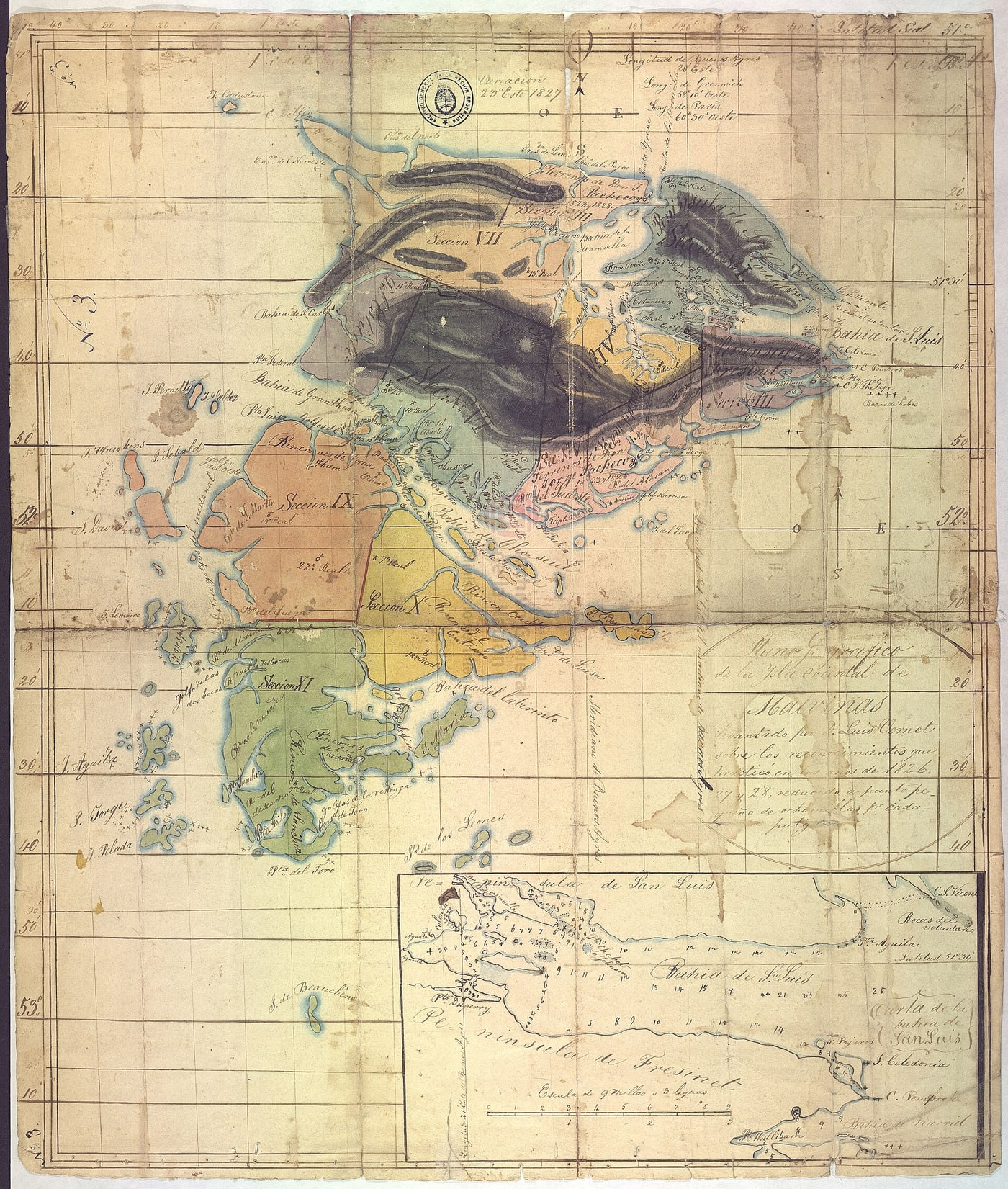
Buenos Aires granted fishing and land rights to Jorge Pacheco and Luis Vernet in 1823; after two failed expeditions Vernet's colony took hold from 1826. In January 1828 the government granted him all of East Falkland with tax exemption conditional on establishing a colony within three years, and the June 1829 decree made him governor with a sealing monopoly, cannon, rifles and tools. He surveyed and mapped the island himself.
Comandante Político y Militar — decree of Buenos Aires, 10 June 1829, naming Vernet Military and Civil Commander of the Falkland Islands and the islands adjacent to Cape Horn
Meaning
Supplies the physical possession that a pure succession argument lacks, and dates the British protest suspiciously late — Britain objected only once the colony became valuable.
The UK rebuts
Britain's answer is that it protested through its consul Woodbine Parish as soon as the decree was known, so the occupation was never unchallenged; that Vernet had sought and obtained British consular assurances for his venture, which is not the conduct of a man exercising Argentine sovereignty; and that the venture was a private commercial concession which ended in his bankruptcy — he later accepted £1,850 in compensation from Britain in 1857 against a claim of £14,295, which Britain reads as personal acquiescence.
Argentina argues that Britain contracted away, by treaty with Spain in 1790, any right to settle in the South Atlantic south of the parts already occupied by Spain, and on the islands adjacent. On this reading Britain's 1833 return was not merely a use of force but a treaty breach, and its silence from 1774 to 1829 was silence because it had bound itself.
Meaning
If accepted, it destroys the British account that the claim slept but survived — because a claim relinquished by treaty does not sleep, it ends.
The UK rebuts
Two answers. Textually, "islands adjacent" to the coasts means coastal islands, not an archipelago three hundred miles offshore, and the article's own terms made it conditional and lapsing. Structurally and more decisively, the United Provinces were not a party to the Nootka Convention: whatever Britain owed Spain, Argentina cannot enforce it, because succession to Spanish territory does not carry succession to Spain's bilateral treaty rights.
original publishedasserted by a governmentThe secret article is given here in substance rather than verbatim; the full convention text is publicFull text — Wikisource
An act of force in peacetime — the official position standing
The Foreign Ministry's standing formulation is that Britain's 1833 action was un acto de fuerza en tiempos de paz — an act of force in peacetime, contrary to international law, never consented to, protested immediately and continuously. Argentina counts more than forty resolutions of the General Assembly and its Special Committee since Resolution 2065 (XX) recognising a sovereignty dispute requiring bilateral negotiation.
…el 3 de enero de 1833 cuando el Reino Unido, quebrando la integridad territorial argentina, ocupó ilegalmente las islas.
Meaning
The doctrinal keystone. Argentina is not arguing that self-determination is a bad principle; it argues that this is a caso especial y particular — a colonial situation involving a dispute over territory rather than over a people, in which paragraph 6 of Resolution 1514 (XV) governs and paragraph 2 does not.
The UK rebuts
"Special and particular" is a category Argentina devised for itself and persuaded sympathetic majorities to repeat; it appears nowhere in the UN Charter. Articles 1(2) and 73 make self-determination general, and the Chagos advisory opinion reaffirmed it as customary law. Calling a population's wishes inadmissible because you dislike the answer is not a legal doctrine — and "illegal occupation" assumes the conclusion the dispute is about.
The unbroken protest and the 1994 Constitution 1833–present; Constitution 1994
Argentina protested the 1833 occupation immediately and has never accepted it: Manuel Moreno's formal protest in London on 17 June 1833, and again in 1841, 1849, 1884, 1888, 1908, 1927, 1933, 1946 and, on Argentina's account, every year since. The First Transitory Provision of the 1994 Constitution wrote the claim into the constitutional text, alongside a commitment to pursue it "in accordance with the principles of international law" — an explicit renunciation of force after 1982. Whether the chain between 1849 and 1884 is unbroken is itself disputed; see the second battleground.
The Argentine Nation ratifies its legitimate and non-prescribing sovereignty over the Malvinas, South Georgia and South Sandwich Islands… as they are an integral part of the National territory. — First Transitory Provision
Meaning
Argentina's position is that acquisitive prescription requires possession that is peaceful and unchallenged, and that an unbroken protest chain is what defeats it. Britain characterises the method as the cheapest available instrument, a note verbale filed in perpetuity.
The UK rebuts
Britain's answer is that protest without possession does not preserve title indefinitely, that the completeness of the chain between 1849 and 1884 is itself disputed, and that the 1982 invasion breached the very principles Argentina now invokes.
The implanted-population doctrine restated 13 July 2026
The current inhabitants are, on Argentina's account, a población implantada — a transplanted population of British nationality installed to replace the population removed in 1833, and therefore not a "people" in the sense of self-determination doctrine, which protects colonised peoples against colonisers rather than settler communities against the state whose territory they occupy.
Time does not transform an illegitimate occupation into sovereignty. — Foreign Minister Pablo Quirno
Meaning
Argentina's position is that the population is not a people entitled to self-determination but a transplanted community whose presence is the consequence of the act complained of. The doctrine denies standing to the roughly 3,662 residents counted in 2021 — about 30% of them temporary — which is why both the referendum figures and the identity figures are contested ground.
The UK rebuts
Two responses. Factually, the Islanders are a settled community of nine or ten generations, longer-established than the population of many recognised states — including much of Argentina's own, which is overwhelmingly descended from nineteenth- and twentieth-century European immigration; if descent from settlers voids a people's rights, Argentina's own title to Patagonia is in difficulty. Doctrinally, nothing in the Charter conditions self-determination on ancestry.
original publishedasserted by a governmentMercoPress
The Islanders 2 sources
Neither party speaks for the people who live there, and both claim to. This section carries their position in their own words and states its limits rather than a rebuttal — they are not one side's evidence, which is exactly how both governments use them.
The Islanders address the Decolonization Committee June 2026
Come and see for yourselves. The resolution before this committee uses the word "interests." We are asking you to recognize our wishes. — Michael Goss, Falkland Islands Legislative Assembly, to the C-24
Islander representatives have petitioned the Decolonization Committee annually for decades. The distinction Goss draws is the one the whole dispute turns on: Resolution 2065 (XX) directs the parties to bear in mind the interests of the population, a word Argentina says was chosen deliberately in place of wishes.
Value / limits
The sharpest formulation of the dispute available from anyone, and it comes from neither government. Its limits: the speaker is an elected member of a legislature Argentina regards as the institution of an occupying power; the community numbered 3,662 at the 2021 census, roughly 30% of them temporary residents, and its identity responses ran 52.3% Falkland Islander, 37.0% British, 10.9% St Helenian, 5.6% Filipino and 4.8% Chilean — which complicates the "implanted British population" framing in both directions; and Britain has an obvious interest in amplifying a voice that agrees with it, which is not a reason to leave it out.
Under the Falkland Islands Constitution Order 2008 the Legislative Assembly has eight elected members, all sitting as independents — there are no political parties. Fisheries are 50–60% of the territory's GDP; the United Kingdom retains defence and external affairs, with the garrison at RAF Mount Pleasant.
Value / limits
Relevant because both narratives describe the Islanders rather than the institutions they run: Britain calls them a self-governing people, Argentina an implanted population under an administering Power. Its limit is that self-government under a constitution granted by one claimant is precisely what the other disputes, so the fact settles nothing — it only shows what is actually there.
Where the two sides read the very same document or event in opposite ways — pick a reading and watch the highlighter move. The initial selection is random.
① January 1833 — expulsion of a population, or removal of a garrison?
I have received directions… in the name of His Britannic Majesty, to exercise the rights of sovereignty over these Islands. It is my intention to hoist to-morrow the national flag of Great Britain on shore when I request you will be pleased to haul down your flag on shore and withdraw your force, taking all stores belonging to your Government. — Capt. James Onslow to Cdr. José María Pinedo, 2 January 1833
The note is addressed to a force. It asks a garrison to withdraw with its government's stores — and that garrison had murdered its own commandant six weeks earlier. The civilians stayed, the storekeeper was left in charge, and the commercial settlement carried on under the same management. That is a change of flag, not an expulsion.
The lawful authorities were removed by armed threat, in peacetime, without prior communication or declaration, and it was protested at once. Whatever happened to the labourers is beside the point — and the record shows people did leave and were paid off in February.
Neither side much dwells on what followed. In August 1833 Antonio Rivero and eight associates killed five leading members of the settlement in a dispute over promissory notes Brisbane had devalued by 60%. Argentine popular history casts Rivero as a patriot resisting British authority; the academic consensus in both countries is that the killings were about pay, not flags. By October the remaining civilians, mainly women and children, had fled to Hog Island and were taken off by a passing sealer. Both the "population that remained" and the "population that was expelled" arguments are arguing about a settlement that dissolved within nine months, for reasons unrelated to sovereignty.
② The Convention of Settlement (1850) — silence as consent?
Article VII — Under this Convention perfect friendship between Her Britannic Majesty's Government and the Government of the Confederation, is restored to its former state of good understanding and cordiality. · The Falkland Islands are not mentioned anywhere in the Convention.
All differences composed, and no reservation entered. Rosas's government signed a treaty declaring friendship restored to its former state and said nothing about the islands. Argentina then filed no protest for thirty-five years. Whatever the 1833 rights were, they were not being maintained.
Territory is not ceded by omission. A treaty about river navigation and blockade cannot dispose of a territorial claim by failing to mention it, and cession requires express words. Foreign Minister Arana attempted a reservation on the Malvinas and Henry Southern refused it — which records an attempt to preserve the claim, not an abandonment of it. And Argentina's answer to the gap is that it is a gap in the record, not a cession — a claim is not surrendered by a period of diplomatic quiet with a far stronger power.
The Convention's text is not in dispute — the islands genuinely do not appear in it. What is disputed is whether the 1849–1884 gap in the protest chain is a lapse or an interruption, and that is the pivot on which the prescription argument turns.
③ Resolution 1514 (XV), 1960 — which paragraph governs?
Para. 2 — All peoples have the right to self-determination; by virtue of that right they freely determine their political status. · Para. 6 — Any attempt aimed at the partial or total disruption of the national unity and the territorial integrity of a country is incompatible with the purposes and principles of the Charter. · Resolution 2065 (XX), 1965 — bearing in mind the interests of the population of the Falkland Islands (Malvinas).
All peoples. Paragraph 2 is general and the Charter's Articles 1(2) and 73 make it so; the Chagos opinion reaffirmed it as customary law. Paragraph 6 addresses breaking up an existing state, and the islands have never been administered by Argentina for more than a few years. "Special and particular" is a category invented for this case and it appears nowhere in the Charter. And a word chosen in 1965 cannot freeze the law against a population that has since voted 99.8%, or against sixty years of development in self-determination doctrine.
National unity and territorial integrity. The General Assembly and its Special Committee have returned to this dispute specifically more than forty times, and in 1965 wrote interests rather than wishes — a deliberate choice. This is a dispute over territory between two states, in which the inhabitants' interests are to be safeguarded but are not the deciding voice.
Paragraphs 2 and 6 of the same resolution have never been reconciled doctrinally. Paragraph 6 was drafted with secession and partition in mind — Katanga, Kashmir — not with settler populations; reading it as a general override of paragraph 2 would have swallowed the decolonisation project, while reading paragraph 2 as absolute would let any colonial power secure territory by settling it and polling the settlers. Spain runs Argentina's argument against Gibraltar, and the UK runs the same reply in both places.
Third-party views 6 sources
This is one of the few disputes carrying an instrument of the Security Council — the UN's only organ that can bind — sixty years of General Assembly practice, annual through the Decolonization Committee since 1983, and a third state, the United States, that has at different moments supplied ammunition to both. Each of the three is read in opposite directions by the two parties.
General Assembly Resolution 2065 (XX) 16 December 1965
Noting the existence of a dispute between the Governments of Argentina and the United Kingdom of Great Britain and Northern Ireland concerning sovereignty over the said Islands… — Resolution 2065 (XX), 16 December 1965
Adopted 94 in favour, none against, 14 abstentions — the United Kingdom abstained rather than opposing. Operative paragraph 1 invites both governments to proceed without delay with negotiations toward a peaceful solution, bearing in mind the Charter, Resolution 1514 (XV), and "the interests of the population of the Falkland Islands (Malvinas)."
Value / limits
The instrument Argentina builds its diplomatic case on, and the reason the dispute is still formally open at the United Nations. The UK notes three things in reply: it is a non-binding recommendation; it directs negotiation, not transfer; and it expressly incorporates Resolution 1514 (XV), which contains the self-determination principle. Its limit as a neutral source is that it settles nothing about title, and the two governments disagree about whether it has been complied with.
Any attempt aimed at the partial or total disruption of the national unity and the territorial integrity of a country is incompatible with the purposes and principles of the Charter of the United Nations. — Resolution 1514 (XV), paragraph 6
Resolution 1514 is the anti-colonial charter: paragraph 2 proclaims self-determination, paragraph 6 protects territorial integrity, and the dispute is at bottom an argument about which governs. Resolution 31/49, adopted 102–1–32 with the United Kingdom the sole vote against, calls on both parties to refrain from unilateral modification of the situation, and is the instrument Argentina invokes against every fisheries licence and seismic survey.
Value / limits
The single most-cited instrument on both sides, and the clearest illustration that this dispute is a collision between two principles rather than a disagreement about facts. Its limit is that neither paragraph was drafted for this case — see the third battleground below — and that the Assembly cannot decide title either way.
The islands are one of the 17 Non-Self-Governing Territories on the United Nations list, with the United Kingdom as administering Power. The Committee has adopted a resolution calling for renewed bilateral negotiations every year since 1983, by consensus, co-sponsored by its Latin American members. Islander representatives petition it annually — they are heard, but not counted. Britain does not accept that the Committee has any role in sovereignty.
Value / limits
What keeps the dispute on the United Nations' active decolonization agenda. Its limits are considerable: the resolutions are hortatory and create no obligation, the Committee's membership is weighted toward states sympathetic to Argentina, and four decades of near-identical texts have produced no movement — which each side reads as proof of the other's intransigence.
Following the Argentine invasion of 2 April 1982, the Security Council demanded withdrawal, adopting Resolution 502 by ten votes to one with four abstentions. The war ended with Argentine surrender on 14 June 1982. The dead numbered 649 Argentine, 255 British and three Islanders.
Value / limits
Both readings are available on the face of the text, which is why it appears here rather than on either side. Argentina's framing of the war is that it was launched by a dying dictatorship — what it called a recuperación — and that a claim then 149 years old, constitutionally committed to peaceful means since 1994, should not be read through it. Britain's framing is that the invasion breached the principles Argentina invokes. Its limit is that Resolution 502 addressed the use of force in April 1982 and says nothing about title: it neither validates nor extinguishes a claim, and both parties agree on that much.
original publisheddetermined by an international bodyFalklands War
The United States — neutral, but not consistently 1831 · 1982 · 2026
Three distinct postures across two centuries. In 1831 the USS Lexington destroyed the Argentine-authorised settlement at Puerto Soledad — fourteen months before the British returned — in retaliation for the seizure of the sealers Harriet, Breakwater and Superior, and its commander, Captain Silas Duncan, declared the islands res nullius, belonging to no one. The raid broke US–Argentine relations for years. In 1982 the United States, after an attempt at mediation, supported Britain materially. Since the war the formal position has been neutrality on sovereignty, recognition of UK de facto administration, and the hedged toponym "Falkland Islands (Islas Malvinas)". A memorandum attributed to Elbridge Colby, leaked in April–May 2026, floated re-evaluating that; Secretary of State Marco Rubio then indicated the position was unchanged — reported, not established.
Value / limits
Both sides quote the United States when it suits them: Britain cites 1831 as proof that a major power treated the islands as ownerless immediately before the British return, and Argentina cites 1982 as proof that Anglo-American alignment, not law, holds them. Its limit is that the United States has never been disinterested here, and Duncan's res nullius declaration was a naval officer's justification for a punitive raid, not a considered United States legal position.
Regional pressure and the scholarly literature 1927–2011
The literature divides along the same line the governments do. Julius Goebel's The Struggle for the Falkland Islands (1927) is broadly favourable to the Spanish and Argentine case; Pascoe and Pepper's work is the most detailed pro-UK rebuttal, written by advocates; Marcelo Kohen is the most credentialled academic advocate of the Argentine case. Lowell S. Gustafson's The Sovereignty Dispute over the Falkland (Malvinas) Islands (Oxford University Press, 1988) is the standard even-handed treatment, and Roberto Laver's The Falklands/Malvinas Case (2001) argues the dispute is legally indeterminate and can only be resolved politically. On the ground, in 2011 the Mercosur bloc agreed to close its ports to vessels flying the Falkland Islands flag — the most concrete material act of regional support. On the other side Canada supports the islanders' self-determination at the OAS, the United States and the EU recognise UK de facto administration without taking a sovereignty position, and the Commonwealth lists the territory as a British Overseas Territory.
Value / limits
Useful because the disagreement is not about what the documents say but about which principle governs them. Its limit is that almost every major work in this field can be located on a side, so provenance is labelled here rather than presented as settled authority — and the two works that are not so located, Gustafson and Laver, reach no verdict on title either.
original publishedGustafson's full text is on the Internet Archive and Laver is catalogued on Open Library; provenance, not availability, is the caution on this cardGustafson (1988) — Internet Archive
Which story do you find more convincing?
Past records are archived forever
counting — split shown once enough votes are in
For reference
Figures recorded elsewhere. A different question was asked, so these do not combine with the vote above.
The 2013 referendum on political status
Falkland Islands · 10–11 March 2013 · 1,672 registered voters
Do you wish the Falkland Islands to retain their current political status as an Overseas Territory of the United Kingdom?
Yes 99.8%1,513 No 0.2%3
Limits Only the islands’ residents voted. Argentina holds no comparable vote and rejects the premise that this electorate is the population entitled to settle the question. Turnout is not shown because the sources give different numbers of registered voters; the vote counts, which the sources agree on, are shown instead.
Vote first — this is where a vote gets its reason.
No lines yet.
The frozen record — never edited, never deleted
Method and limits. Compiled 2026-08-24 from a three-track research pass (British grounds / Argentine grounds / third parties). Three cautions. First, the 1833 demography is contested — accounts of the roughly 22 people said to have remained differ and are secondary, and the settlement dissolved within nine months in any case. Second, the completeness of the Argentine protest chain between 1849 and 1884 is itself disputed, and is presented here as disputed rather than resolved. Third, the scholarly literature is largely partisan, so each work is named with its provenance rather than cited as neutral authority. Badges follow the two grades defined in the editorial principles: original published = images or full text publicly available; copies published = the original is lost or unavailable and the text survives in transmission. Islander and third-party cards state their limits in place of a rebuttal, since they are not one side's evidence.
Editorial principles. ① Name order follows the language edition; this English edition uses the UN's negotiated form, "Falkland Islands (Malvinas)." ② The order of the two narrative sections is randomized on every visit. ③ Every dispute is labelled with its de facto controller, and every card in the two narratives carries the other side's rebuttal.
Vernet's own survey of Isla Soledad / East Falkland, 10 June 1829
Public domain · Louis Vernet (1791 - 1871) · Wikimedia Commons · Drawn from his reconnaissances of 1826–28, and dated the same day as the Buenos Aires decree naming him Comandante Político y Militar
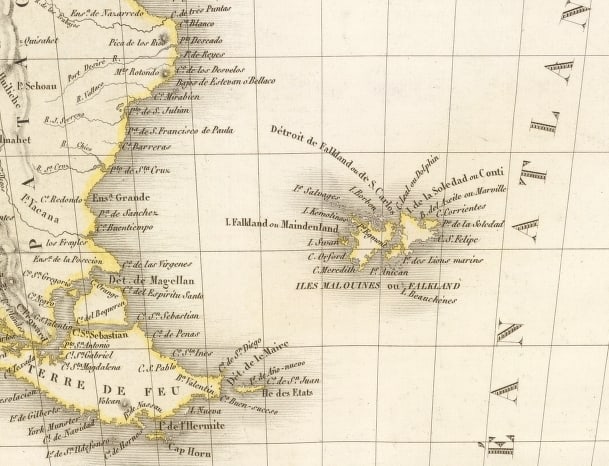
Lapie, Atlas universel, 1833
Public domain · Pierre y Alexandre Emile Lapie · Wikimedia Commons · A French map from the year of the British return — a third party’s cartography from the moment the dispute begins