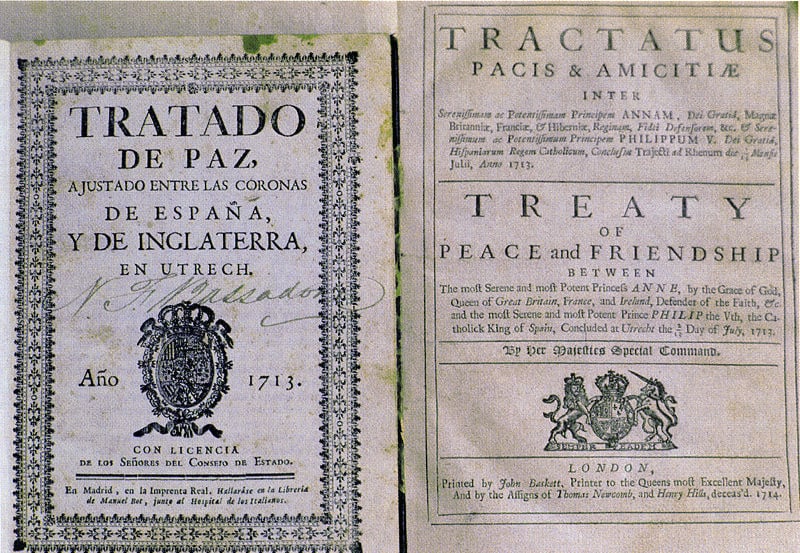
The Treaty of Utrecht, 1713
Public domain · The_Treaty_of_Utrecht.jpg · Wikimedia Commons · Article X is the text both governments have argued from for three centuries
The documentary evidence behind both official narratives, with the accessibility of each original noted. Every card in the two narratives carries the other side's rebuttal; third-party cards state their own limits instead. This document endorses neither claim.
VOTE Which story do you find more convincing? Naming rule Both states call the territory Gibraltar, so there is no name to order — but the surrounding vocabulary is contested: Spain says la Verja ("the fence") and colonia, Britain says "the frontier" and "British Overseas Territory" · The order of the two narrative sections below is randomized on every visitProvisional application of the UK–EU treaty begins. All physical barriers at the La Línea crossing are removed and the fence erected around 1908–09 comes down.
Treaty signed in Brussels by Stephen Doughty and Maroš Šefčovič, witnessed by Chief Minister Picardo and Foreign Minister Albares, and approved unanimously by the Gibraltar Parliament. Doughty said it "safeguards British sovereignty"; Spain said it leaves its sovereignty position intact.
Picardo addressed the UN Decolonization Committee again, demanding delisting: "Sixty-three years of silence is not neutrality." He described the appearance as a farewell.
EU member states green-light the treaty in Council.
Spain published the official Spanish text of the treaty with an explanatory infographic, circulated to Campo de Gibraltar institutions.
The UK and the EU publish the draft treaty text.
The UK restated both locks to the UN Fourth Committee: no transfer of sovereignty against Gibraltarians' wishes, and no sovereignty process they are not content with.
The UK, Spain and Gibraltar agree the New Year's Eve political framework that became the basis for the treaty.
Collected automatically and summarised by machine. Nobody reads these before they appear. Follow a link for what the outlet actually published.
⇄ The order of the two narrative sections below is randomized on every visit — this dossier takes no side, not even in sequence.
A valid cession in perpetuity by the lawful sovereign, reaffirmed by four later treaties and never interrupted in 322 years — and, since 1967, a population that has twice been asked and has twice refused to change sovereign by margins of 99% and 98%.
Article X of the Peace and Friendship Treaty ending the War of the Spanish Succession. The cession was confirmed by four subsequent treaties — Seville 1729, Aix-la-Chapelle 1748, Paris 1763 and Versailles 1783 — and Britain has held the territory continuously since. Both states agree Article X remains in force, and both agree some of its paragraphs (the exclusion of Jews and Moors) are no longer operative.
Held under British administration after Spain formalised its claim, offering a genuine alternative on terms Spain itself had specified. The result was 12,138 votes for retaining the British link and 44 for Spanish sovereignty — 99.64% to 0.36% of valid votes. Turnout is given as 95.8% by the Gibraltar Government and 96.57% by other sources. 10 September has been Gibraltar National Day since 1992.
On 12 July 2002 Foreign Secretary Jack Straw told the Commons that Britain and Spain were in broad agreement on principles for a settlement, including shared sovereignty. Gibraltar's Government called its own referendum. The result was 187 Yes to 17,900 No — 98.97% against on valid votes, turnout 87.9%. The UK abandoned the joint-sovereignty track and has not revived it.
Made 14 December 2006 and in force 2 January 2007, replacing the 1969 Order. It gives Gibraltar full internal self-government — elected Parliament, Chief Minister, own courts and tax system — with foreign affairs, defence and internal security reserved to the UK through a Governor. It was approved in a Gibraltar referendum on 30 November 2006 by 60.42% on a 60.4% turnout — a far narrower margin than 1967 or 2002. The preamble carries the commitment quoted above; UK policy since 2002 has extended it to a second lock, that Britain will not enter sovereignty negotiations with which Gibraltar is not content.
Britain does not claim the isthmus under Article X alone. It argues title by prescription — continuous, open and peaceful possession for more than two centuries, with Spanish acquiescence at key moments, including Spain's agreement to the 1815 barracks built during a yellow-fever epidemic. It also argues that the fortifications along the present frontier line formed part of the works originally ceded. Gibraltar's Chief Minister told the C-24 in June 2025 that "the whole of our territory — isthmus and waters included — must remain intact during the decolonisation process."
Signed in Brussels by Stephen Doughty for the UK and Maroš Šefčovič for the European Commission, witnessed by Chief Minister Picardo and Foreign Minister Albares, and approved unanimously by the Gibraltar Parliament. The treaty exists because of Brexit: Gibraltar voted 95.91% to remain in the European Union in the referendum of 23 June 2016 — the strongest remain vote anywhere eligible — and left with the United Kingdom regardless. Provisional application began 15 July 2026: all physical barriers at the La Línea land crossing were removed, dual controls were introduced at the airport and port with Spanish officers performing Schengen checks under EU authority, and Gibraltar entered a customs union with the EU. Full ratification is not complete — the EU still requires European Parliament consent and a Council decision, and the UK the CRAG Act scrutiny period.
Article X ceded enumerated works and expressly withheld territorial jurisdiction; the isthmus was never ceded at all; and sixty years of General Assembly doctrine has classified Gibraltar as a colonial situation to be ended by bilateral negotiation restoring Spanish territorial integrity — not by consulting a transplanted population.
The Anglo-Dutch force took Gibraltar in the name of Archduke Charles of Austria, the Habsburg claimant to the Spanish throne, not in the name of Great Britain. Almost the entire population left the town on 7 August, settling at San Roque. The surrender terms had guaranteed lives and property to those who swore loyalty to Charles III. The present community descends from later Genoese, Portuguese, Maltese, Jewish and British settlement.
Spain's position, stated on its foreign ministry's own Gibraltar page, is that the treaty ceded propiedad in enumerated works — city, castle, port, defences, fortress — and expressly withheld jurisdicción territorial. The text names human edifices, not the peninsula's natural features; on this reading the eastern face of the Rock, the isthmus, the waters and the airspace were never conveyed. The prohibition on open land communication is, Spain says, the treaty's own proof that no landward territory came with the deal.
Spain treats the final paragraph of Article X as fully in force and as the legal reason independence is not available to Gibraltar. Britain agrees. Foreign Secretary Margaret Beckett's Despatch accompanying the 2006 Constitution Order states that HMG supports Gibraltarian self-determination "except in so far only as… Article X of the Treaty of Utrecht gives Spain the right of refusal should Britain ever renounce sovereignty… independence would only be an option for Gibraltar with Spain's consent." The same Despatch then records that "Gibraltar does not share the view that this constraint exists and that their acceptance of this Constitution is on that basis."
The isthmus connecting the Rock to the mainland is not named in Article X. British occupation of it advanced through the eighteenth and nineteenth centuries — a neutral ground, then barracks in 1815 during a yellow-fever epidemic, then a fence in 1908–09, then an airfield built across it in 1938–39. Spain protested at each stage and has never accepted any of it.
Spain's case rests on the doctrine the General Assembly has actually applied to Gibraltar. The 1964 C-24 Consensus found a dispute between the UK and Spain, invited negotiations under Resolution 1514 (XV), and referred to the intereses — the interests — of the inhabitants, a formula deliberately weaker than the "wishes" language used for other territories. Since the 1970s the Assembly’s annual output on Gibraltar has taken the form of a consensus decision calling for bilateral negotiation.
The Lisbon Declaration of 1980 committed both parties to resolve the problem in accordance with the relevant resolutions and to restore communications; the Brussels Declaration of 1984 went further and committed Britain to discuss sovereignty. The frontier reopened in 1985. The trilateral Forum of Dialogue that followed produced the Córdoba Agreement of 2006 on the airport, pensions, telecommunications and border flows. The Forum then collapsed. It had already stalled from 2009 over the waters dispute; Spain then sought to restructure it, Gibraltar read the proposal as a demotion of its seat, and the UK refused to alter what had been agreed. The mechanism has not been revived, and the causes remain contested.
Where the two sides read the very same document in opposite ways — pick a reading and watch the highlighter move. The initial selection is random.
…cede por este Tratado a la Corona de la Gran Bretaña la plena y entera propiedad de la ciudad y castillo de Gibraltar, juntamente con su puerto, defensas y fortaleza que le pertenecen, dando la dicha propiedad absolutamente para que la tenga y goce con entero derecho y para siempre, sin excepción ni impedimento alguno.
Absolutely, with entire right, for ever, without exception. That is full sovereign title, perpetual and unqualified, granted by the lawful sovereign and reaffirmed in four later treaties. Read those words and the case is closed.
An enumerated list of works. City, castle, port, defences, fortress. No peninsula, no isthmus, no waters, no airspace. What is not listed was not ceded, and an instrument of 1713 has no implied territorial annexes.
Both governments print both texts and neither disputes a word of them. The whole dispute is visible in about 120 words of 1713 legalese.
Pero, para evitar cualesquiera abusos y fraudes en la introducción de las mercaderías, quiere el Rey Católico… que la dicha propiedad se ceda a la Gran Bretaña sin jurisdicción alguna territorial y sin comunicación alguna abierta con el país circunvecino por parte de tierra.
Read the clause's own preamble. It says why it exists: to prevent abuses and frauds in the introduction of merchandise. It is a customs stipulation about landward trade and about jurisdiction over the surrounding Spanish countryside — it cannot cancel the plenary grant made one sentence earlier without making the article contradict itself.
Territorial jurisdiction was expressly withheld. Britain was given property in works, not a territory. Everything landward of the 1713 walls — the isthmus, the airfield, the waters, the airspace — is therefore occupied, not owned.
No court has ever ruled on Article X. The interpretive dispute is genuine and unresolved.
Párr. 2 — Todos los pueblos tienen el derecho de libre determinación. … Párr. 6 — Todo intento encaminado a quebrantar total o parcialmente la unidad nacional y la integridad territorial de un país es incompatible con los propósitos y principios de la Carta. … Consenso del C-24 de 1964 — teniendo en cuenta los intereses de los habitantes del territorio.
All peoples. Paragraph 2 is the operative rule and Gibraltarians are a people by every ordinary test — shared history, institutions, self-identification. Paragraph 6 addresses breaking up an existing state, and Gibraltar has not been part of Spain since 1704, so there is nothing to break. The ICJ's 2019 Chagos opinion tied decolonisation to the freely expressed will of the people concerned.
National unity and territorial integrity. The Assembly applied paragraph 6 to Gibraltar specifically and repeatedly, and in 1964 chose the word intereses — interests — rather than the "wishes" formula used for other territories. That choice was deliberate: the inhabitants' interests are to be taken into account, but the decolonisation is a bilateral matter between two states.
Paragraphs 2 and 6 of the same resolution have never been reconciled doctrinally. The General Assembly has applied paragraph 6 to only a handful of cases — Gibraltar and the Falklands/Malvinas being the paradigm examples.
Gibraltar is one of very few disputes where international institutions have taken sustained formal positions — and where those positions point in different directions: the General Assembly has treated it as a colonial situation to be ended bilaterally, while the courts that have actually ruled have ruled on the franchise, and in Britain’s favour.
Gibraltar was a garrison with a civilian population grafted onto it until 1830, when it was formally made a Crown Colony, given a Charter of Justice and a civilian magistracy. That is the classification the UK reported to the UN as a Non-Self-Governing Territory in 1946, and the Special Committee on Decolonization has carried it on the list since 1963. It is still listed in 2026. The 1964 C-24 Consensus is the pivot: it found a dispute between the UK and Spain, invited negotiations under Resolution 1514 (XV), and referred to the "interests" of the inhabitants — deliberately weaker than the "wishes" language used elsewhere. Picardo addressed the Committee in June 2025 and again in June 2026 demanding delisting: "Sixty-three years of silence is not neutrality. It is a failure of this committee's most basic duty."
Paragraph 2 is the charter of self-determination; paragraph 6 is the territorial-integrity safeguard. The two have never been reconciled doctrinally, and the General Assembly has applied paragraph 6 to only a handful of cases, Gibraltar and the Falklands/Malvinas being the paradigm examples. Resolution 1541 (XV) supplies the menu of outcomes by which a territory reaches a full measure of self-government: independence, free association, or integration with an independent state.
In Legal Consequences of the Separation of the Chagos Archipelago from Mauritius in 1965 the Court addressed the relationship between decolonisation, territorial integrity and popular will — the first modern ICJ pronouncement tying the three together. It went against the United Kingdom. Spain reads the opinion as confirming that territorial integrity in decolonisation is customary law, and that the continued administration of a listed territory can itself be an internationally wrongful act.
In Matthews v United Kingdom (18 February 1999) the European Court of Human Rights found the UK in breach of Article 3 of Protocol No. 1 for failing to hold European Parliament elections in Gibraltar, which was bound by EC law it had no vote in making. The UK responded with the European Parliament (Representation) Act 2003, attaching Gibraltar to South West England from 2004. Spain then sued: in Kingdom of Spain v United Kingdom (Case C-145/04), the Grand Chamber ruled on 12 September 2006, objecting in particular to the enfranchisement of Commonwealth citizens resident in Gibraltar. The Court dismissed Spain’s action.
Alejandro del Valle Gálvez, Professor of Public International Law at the Universidad de Cádiz and the most cited Spanish academic on Gibraltar, assesses that the UN framework is "markedly favourable to Spain" — fifty years of resolutions classifying Gibraltar as pending decolonisation through bilateral talks — but that it delivers nothing, because Britain conditions negotiations on Gibraltarian consent and Gibraltar withholds it. He also notes that Britain has never supplied a documented answer to Spain's isthmus protests beyond wartime military necessity.
Figures recorded elsewhere. A different question was asked, so these do not combine with the vote above.
The 2002 referendum on joint sovereignty
Gibraltar · 7 November 2002 · 20,675 registered voters
Do you approve of the principle that Britain and Spain should share sovereignty over Gibraltar?
Limits The referendum was organised by the Government of Gibraltar, not by the United Kingdom, and Spain told the United Nations that it had no legal validity or effect. Only Gibraltar’s residents voted. The Gibraltar government’s own published result is no longer reachable online, so the figures here come from the IFES election database rather than from the returning officer.
IFES Election Guide — Gibraltarian Referendum 2002UN Fourth Committee, press release GA/SPD/261, 8 October 2003, recording both the Gibraltar and the Spanish statements
Votes per hour. A surge is not hidden here — it is drawn.
One line, from people who voted. No replies. Your side and country are shown with it.
Three places this page found the readings diverge
Vote first — this is where a vote gets its reason.
No lines yet.
Method and limits. Compiled 2026-08-24 from a three-track research pass (British and Gibraltarian grounds / Spanish grounds / third parties), with every URL verified live. Two notes specific to this dispute. First, there is no naming dispute over the territory — both states say Gibraltar — but the surrounding vocabulary is contested at every turn: la Verja against "the frontier," colonia against "British Overseas Territory." Second, the documentary record is unusually shared: Spain's Foreign Ministry prints the English text of Article X and the UK's Beckett Despatch is reproduced in a Spanish academic compilation, so almost nothing here turns on whether a document exists. Where figures diverge — the 1967 turnout, the 2002 percentage, the daily cross-frontier workforce — both are given rather than one chosen. Third-party cards state their limits in place of a rebuttal, since they are not one side’s evidence. Badges follow the two grades defined in the editorial principles: original published = images or full text publicly available; copies published = transmitted otherwise. No neutral Spanish vocabulary exists for the status of the territory — every available term takes a side — which is itself worth saying rather than papering over.
Editorial principles. ① Name order follows the language edition; here both parties use the same name, so the contested vocabulary is labelled instead of ordered. ② The order of the two narrative sections is randomized on every visit. ③ Every dispute is labelled with its de facto controller, and every source carries the other side's rebuttal.
TRATADO DE PAZ Y AMISTAD · UTRECHT
ARTÍCULO X · 13 DE JULIO DE 1713
The three clauses, in order
El Rey Católico… cede por este Tratado a la Corona de la Gran Bretaña la plena y entera propiedad de la ciudad y castillo de Gibraltar, juntamente con su puerto, defensas y fortaleza que le pertenecen, dando la dicha propiedad absolutamente para que la tenga y goce con entero derecho y para siempre, sin excepción ni impedimento alguno. — Pero, para evitar cualesquiera abusos y fraudes en la introducción de las mercaderías, quiere el Rey Católico… que la dicha propiedad se ceda a la Gran Bretaña sin jurisdicción alguna territorial y sin comunicación alguna abierta con el país circunvecino por parte de tierra. — Si en algún tiempo a la Corona de la Gran Bretaña le pareciere conveniente dar, vender o enajenar, de cualquier modo la propiedad de la dicha Ciudad de Gibraltar, se ha convenido y concordado por este Tratado que se dará a la Corona de España la primera acción antes que a otros para redimirla.
Utrecht, 13.VII.1713
Typeset from the Spanish text as printed by Spain's own Foreign Ministry in La cuestión de Gibraltar (Madrid, 2008) and reproduced in the Elcano documentary compilation · the English text is at Wikisource
The Treaty of Utrecht, 1713
Public domain · The_Treaty_of_Utrecht.jpg · Wikimedia Commons · Article X is the text both governments have argued from for three centuries